
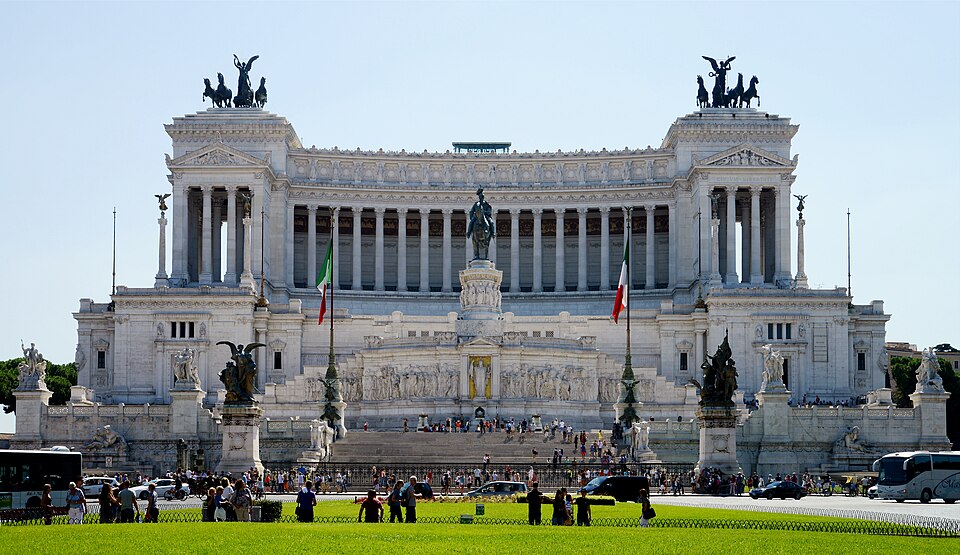
Piazza Venezia & Altare della Patria
- monument
- piazza
- Price: Free (panoramic elevator: €10)
- Opening hours: 09:30 - 19:30
History
Rome announced an international design competition in 1885 for a monument that would celebrate Victor Emmanuel II, the first king of a united Italy, who had died six years earlier. The Marche-born architect Giuseppe Sacconi won, and construction began that same year on a stretch of the Capitoline Hill's northern slope, requiring the clearance of a dense medieval quarter and part of the hill itself. Sacconi died in 1905, well before the work was finished, and the project passed to a trio of architects — Manfredo Manfredi, Pio Piacentini and Gaetano Koch — who carried it through to formal completion in 1935, though the monument was inaugurated, still unfinished, in 1911 to mark the fiftieth anniversary of Italian unification.
After the First World War, the monument gained its most solemn feature: in 1921, the remains of an unidentified Italian soldier, selected from among unknown war dead exhumed from battlefields across the country, were brought to Rome and interred beneath the statue of the goddess Roma at the monument's base. The Tomb of the Unknown Soldier has been watched over by an honour guard from the Italian armed forces ever since, and its eternal flame — tended day and night — turned a monument built to celebrate a king into one that also mourns an entire generation of ordinary soldiers.
Did you know?
Locals have never quite warmed to the Vittoriano, and its nicknames say as much: "the wedding cake" for its tiered, frosting-white profile, and "the typewriter" for the way its columned steps resemble old typewriter keys. Sculpted from gleaming Botticino marble on a hill otherwise built from Rome's warm travertine and ochre stucco, the monument stands out — deliberately, but not always happily; early twentieth-century Futurist critics went further and likened it to an oversized bathroom fixture. Even so, it has become one of the most photographed backdrops in the city, proof that a monument can be simultaneously mocked and beloved.
The neighbouring Palazzo Venezia, which lends the square its name, has its own weighty history: Benito Mussolini kept his office in its Sala del Mappamondo through the 1930s and addressed enormous crowds gathered below from its balcony, including the 1936 proclamation of the Italian Empire and the 1940 declaration of war. The balcony has been sealed since the fall of Fascism, but it remains one of the square's most pointed reminders that Piazza Venezia has witnessed more than one chapter of Italian history.
Good to know
The monument's lower terraces, porticoes and the Tomb of the Unknown Soldier are free to visit and open to anyone walking through the square — there's no ticket needed to see the eternal flame or admire the bronze quadrigas up close. The glass panoramic elevator to the rooftop terrace, however, is a separate paid attraction with its own ticket line, entirely independent from the free monument areas below.
That rooftop terrace is genuinely one of Rome's best viewpoints: a 360° panorama that takes in the Roman Forum, the Colosseum, the Capitoline and St Peter's dome, and it tends to draw noticeably shorter queues than its view would suggest. Piazza Venezia itself is one of the busiest traffic hubs in central Rome, so use the pedestrian crossings and underpasses rather than crossing on a whim, and try to visit in late afternoon, when the low sun turns the white marble gold.