
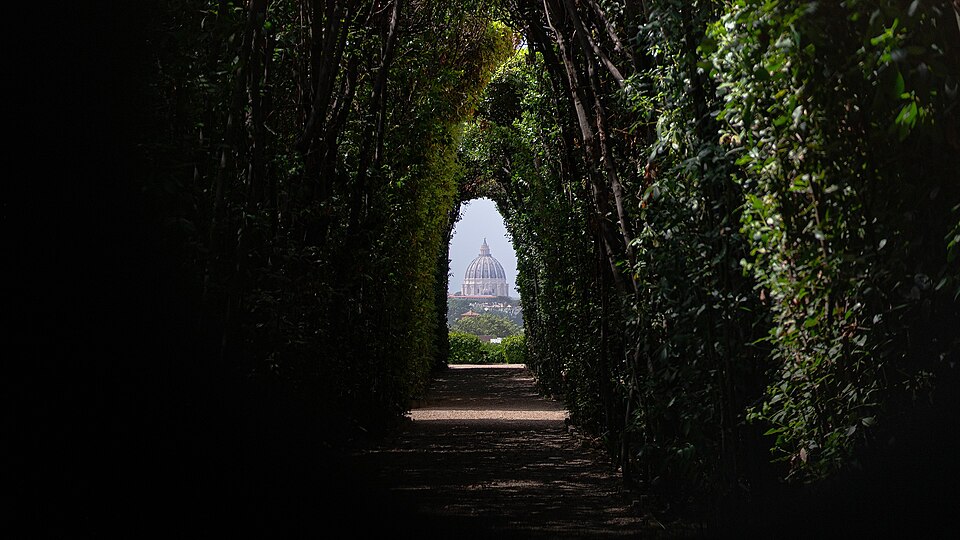
The Aventine Keyhole
- hidden-gem
- Price: Free
- Opening hours: Always open
Book a guided tour of Roma
Skip the line and see Roma with a local guide.
History
The ground the piazza sits on has a long institutional pedigree. In the 10th century it held a fortified residence belonging to Alberic II, the nobleman who effectively ruled Rome from 932 to 954; it later became a Benedictine monastery, and by the 14th century had passed to the Knights Hospitaller, the order now known as the Sovereign Military Order of Malta. The square itself, Piazza dei Cavalieri di Malta, was laid out in 1765 by Giovanni Battista Piranesi, the etcher famous for his sweeping views of Roman ruins — one of only two architectural commissions he ever saw built, together with the adjoining church of Santa Maria del Priorato.
Piranesi filled the piazza with maritime and funerary symbolism, likening the Aventine Hill to a ship setting sail for the Holy Land, with obelisks standing in for masts and carved motifs for rigging and rope. At the end of the garden path leading to the Priory's gate, he lined the walk with clipped hedges trimmed into a tunnel, engineering a "telescope effect" so precise that the dome of St Peter's Basilica, kilometres away across the city, appears perfectly framed the moment you look through the keyhole.
Did you know?
The keyhole's fame rests on more than one lucky architectural accident: peer through it and the sightline is said to cross three sovereign territories at once. The foreground garden belongs to the extraterritorial property of the Knights of Malta — an order that governs no populated territory yet is recognised under international law as a sovereign entity, complete with its own passports, licence plates, and postage stamps. The middle distance, the Aventine Hill itself, is ordinary Italian soil. And the dome rising above the rooftops in the background stands inside Vatican City. Three countries, one keyhole.
A small plaque beside the gate spells this out formally: it reads "Sede Extraterritoriale," confirming that the strip of garden just beyond the door is not, legally speaking, part of Italy at all — a quirk that traces back to the Lateran Pacts of 1929, the same agreements that established Vatican City as an independent state.
Good to know
The keyhole is free, unguarded, and technically open around the clock, since it's simply set into the gate of a public square rather than a ticketed site. Early morning and late afternoon tend to bring the softest light for photos and the shortest queue — on a busy day, you may find a short, good-natured line of visitors patiently taking turns for a look. The piazza itself is otherwise unremarkable, so keep an eye out for a small crowd clustered around a plain green door; that's the giveaway you've found the right spot.
Since a phone camera can struggle to focus through the dark hedge tunnel, most visitors get a cleaner shot by holding the lens directly against the metal keyhole rather than shooting from a distance. It's an easy stop to combine with a five-minute walk to the Giardino degli Aranci in Parco Savello, an open, unobstructed terrace with its own sweeping view over Rome and the Tiber, and with the Basilica of Santa Sabina next door, one of the best-preserved early Christian basilicas in the city, dating to the 5th century.