
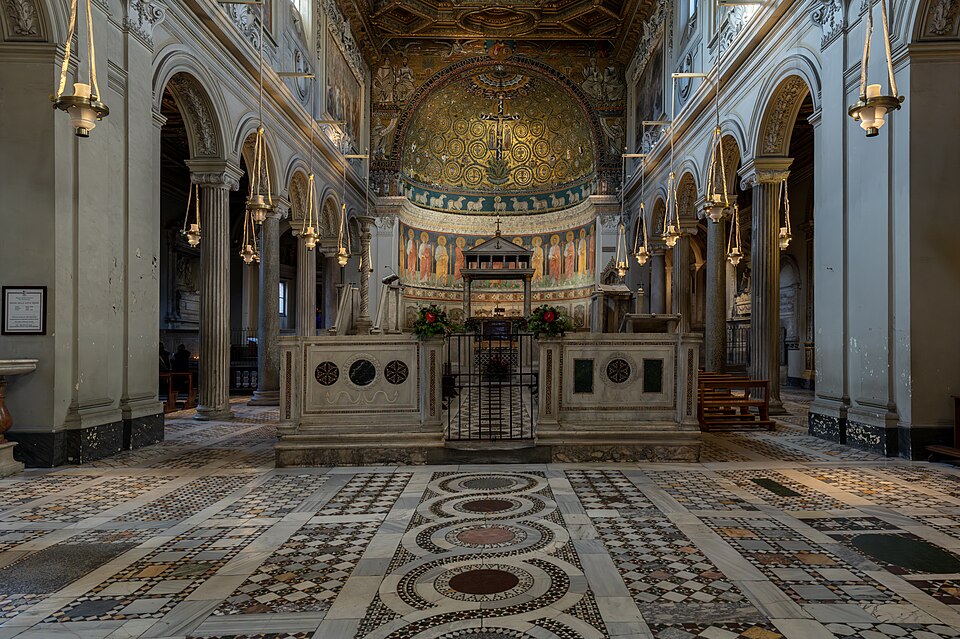
Basilica of San Clemente
- sacred
- hidden-gem
- Price: Free (underground levels: €10)
- Opening hours: 09:00 - 12:30, 15:00 - 18:00
History
The basilica visible today is dedicated to Pope Clement I, one of the earliest bishops of Rome, and was built in the early 12th century after a Norman army under Robert Guiscard sacked this part of the city in 1084, badly damaging the much older church that had stood on the site for centuries. Rather than clear away the ruined building, the medieval builders filled it with earth and rubble and raised the new basilica directly on top of its foundations — a decision that, without anyone intending it, sealed and preserved everything underneath for the next seven hundred years.
Since the late 17th century, San Clemente has been in the care of Irish Dominican friars, driven from Britain and Ireland by anti-Catholic laws, who took charge of the church in 1677. It was one of their own, Father Joseph Mullooly, who in 1857 began digging beneath the basilica's floor, intrigued by old references to an earlier church supposedly buried on the same site — and uncovered, level by level, one of the most remarkable archaeological finds in Rome.
Three Churches, One on Top of the Other
Descend below the current floor and you enter the earlier basilica, built around the 4th century and deliberately buried, rubble and all, when the newer church was raised above it. Its walls still carry fresco cycles painted between the 9th and 11th centuries, faded but legible — saints and biblical scenes that survived precisely because no one could see or touch them for seven hundred years, until Mullooly's excavation reached them again in the 1860s.
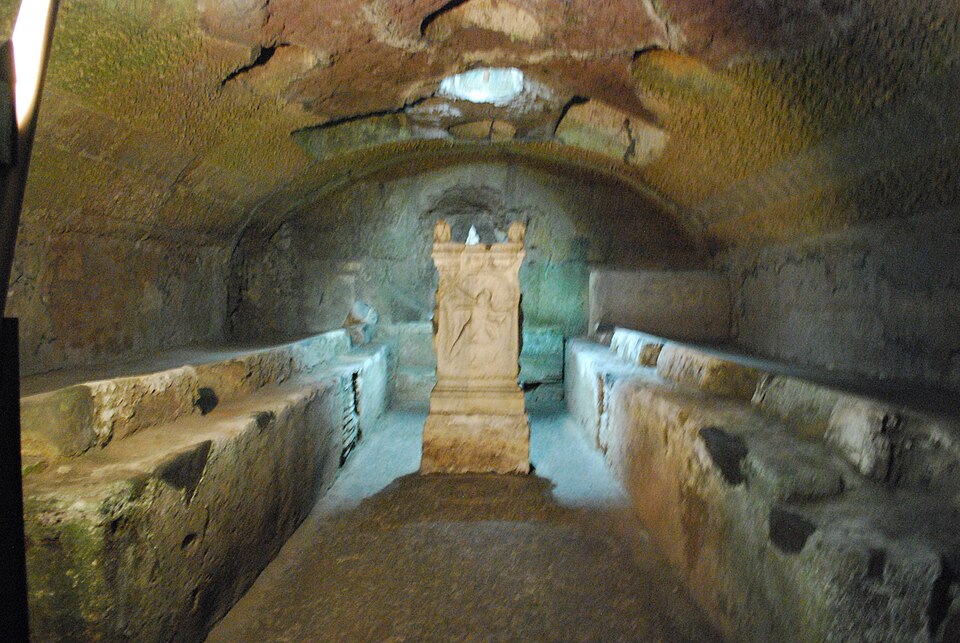
One level further down, cut into the bedrock, are the remains of a 1st-century Roman house standing beside what was probably a mint, and inside the house, a mithraeum: a small, windowless shrine built for the worship of Mithras, a god of Persian-inspired origin whose all-male mystery cult, built around secret initiation rites, was especially popular with Roman soldiers between the 1st and 4th centuries AD. Initiates once gathered here, around a stone altar and benches, in near-total darkness. Walk to the lowest point of the complex today and you can still hear — and in one spot see — a spring of running water threading through an ancient channel whose ultimate source has never been fully traced.
Did you know?
One fresco in the middle-level church is treasured by linguists as much as art historians: it shows a Roman nobleman named Sisinnius, tricked by a miracle into dragging a stone column instead of the escaped Saint Clement, cursing at his slaves to pull harder. He doesn't speak in Latin, but in an early, everyday form of Roman speech close to Italian — making the inscription one of the oldest surviving written examples of the Italian vernacular, predating Dante by roughly two centuries.
The lower levels stayed sealed and forgotten for so long that even the friars living directly above them, generation after generation, had no idea what lay beneath their own church. It took a 19th-century prior digging on little more than a hunch, chasing a handful of old texts that mentioned an "earlier San Clemente," to bring any of it back into the light.
Good to know
The upper basilica is free to enter, but the underground levels require a separate paid ticket, bought at a desk inside the church — there's no way to see them for free, though no advance online booking is needed for a standard self-guided visit. Photography is not permitted once you go below ground, so this is one Roman sight best taken in with your own eyes rather than through a camera screen.
The deepest levels sit several metres below street level and stay noticeably cooler and more humid than the church above, even during Rome's hottest months, so a light layer is worth bringing along even in summer. Set aside at least 45 minutes for the full descent through all three levels — more if you want to linger over the frescoes and read the information panels along the way.