
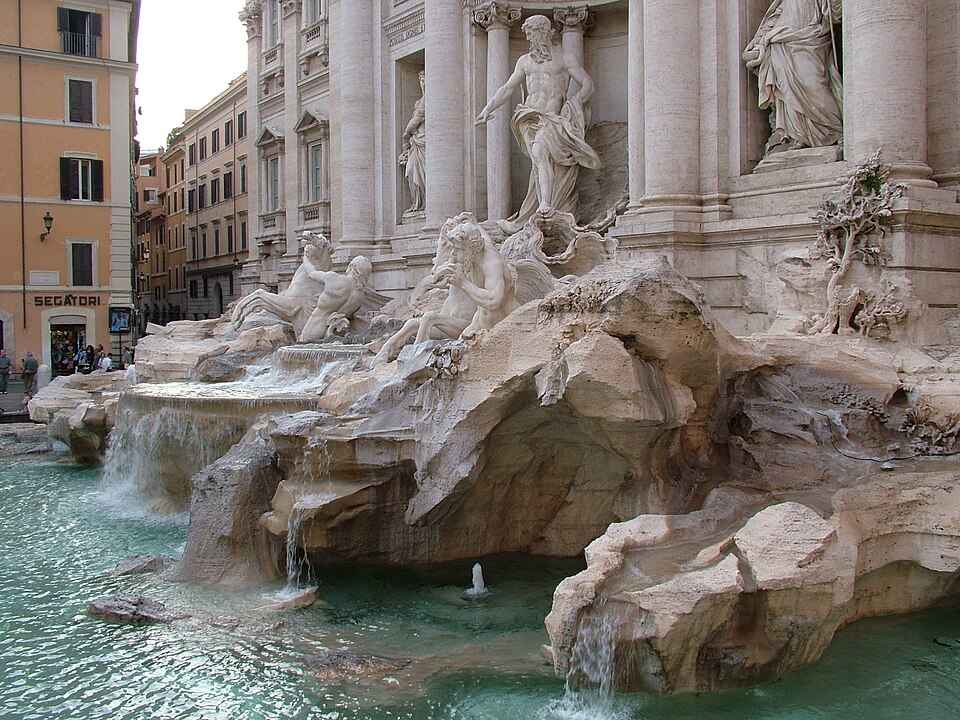
Trevi Fountain
- monument
- Price: Free
- Opening hours: 24/7
History
The fountain that fills Piazza di Trevi today is the result of a contested, decades-long design process. In 1730 Pope Clement XII opened a competition for a monumental fountain on the site, and although the Florentine architect Alessandro Galilei won it, a public outcry over a non-Roman taking the commission led the pope to hand the project to the Roman runner-up, Nicola Salvi, instead. Construction began in 1732, and Salvi spent the rest of his life on it; when he died in 1751, the fountain was still only half-built. Giuseppe Pannini took over, adjusted parts of the original design, and finally completed the work in 1762 — thirty years after the first stone was laid, and eleven years after Salvi's death.
The Trevi is not a free-standing sculpture but the ornamental endpoint of the Aqua Virgo, an aqueduct built by Marcus Agrippa in 19 BC to supply water to Rome's public baths. Unlike most of the city's ancient aqueducts, the Virgo never fell entirely out of use; restored and rerouted many times over two millennia, it is still, in modified form, the source that feeds the fountain today — a working link back to Augustan Rome hiding beneath Salvi's baroque stagecraft.
Did you know?
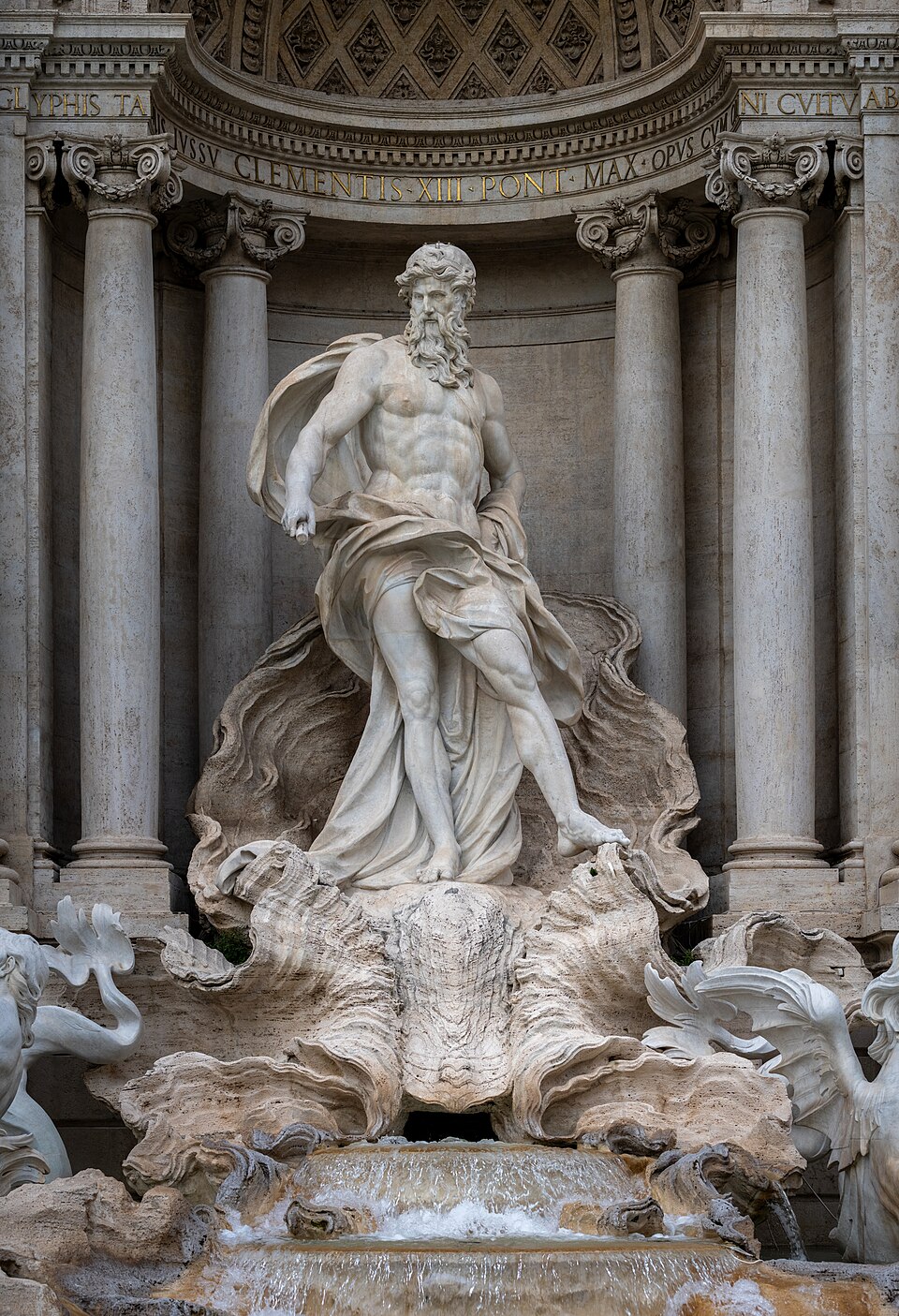
The imposing figure commanding the fountain's central niche is often mistaken for Neptune, but he is actually Oceanus, the Titan who in Greek mythology personified the great river believed to encircle the world. He's flanked by two allegorical figures carved by Filippo della Valle: Abundance, pouring water from an overturned urn, and Salubrity, holding a cup from which a snake drinks — a nod to the purity of the Aqua Virgo's water. The name Trevi itself most likely comes from "tre vie," the three streets that once converged at this spot.
The fountain earned a second, more cinematic fame in 1960, when Federico Fellini filmed Anita Ekberg wading through it at night in a black evening gown for La Dolce Vita, beckoning a nervous Marcello Mastroianni to join her. The scene, now one of the most referenced images in film history, took a full week of chilly March nights to shoot — Ekberg reportedly braved the icy water in little more than the dress, while Mastroianni needed a wetsuit underneath his suit to get through it.
The Coin-Toss Tradition
The fountain's best-known ritual is simple: stand with your back to the water and toss a coin over your left shoulder with your right hand. According to popular belief, one coin guarantees you'll return to Rome one day; a second is said to bring romance with an Italian; a third, marriage. Tradition calls for each coin to be thrown separately, one wish at a time, rather than all together in a single toss.
All those wishes add up to real money: city workers sweep an estimated one to one-and-a-half million euros in coins from the basin each year. The proceeds are donated to Caritas, the Catholic charity, which channels the funds into a food bank, a soup kitchen, and welfare programmes for people in need across Rome — meaning the coin you throw does some good whether or not the wish comes true.
Good to know
The Trevi is one of the most photographed spots on Earth, and the piazza is crowded from mid-morning until well into the night, in every season. For a photo without a wall of people in it, come before 8am: the fountain looks exactly the same, but the crowds haven't arrived yet, and the early light on the travertine is a bonus.
A city ordinance protects Rome's historic fountains, so sitting, eating, or drinking at the fountain's edge is banned, with fines from roughly €40 to €240; wading into the water carries a steeper penalty starting around €450. Since February 2026, getting right up to the basin edge — to toss a coin or take a close-up photo — also requires a €2 ticket, bought on the spot by card or QR code, valid between 9am and 10pm (from 11:30am on Mondays and Fridays); after 10pm access to the edge is free again, as is viewing the fountain from anywhere else in the piazza. Residents of Rome, children under five, and visitors with disabilities are exempt.