
Vatican Museums
- art-museum
- museum
- Price: €17 - €21
- Opening hours: 08:00 - 18:00 (closed Sundays, except the last of the month)
History
The Vatican Museums trace their beginning to a single discovery. In January 1506, a farmer digging in his vineyard near Santa Maria Maggiore unearthed an extraordinary ancient marble sculpture. Pope Julius II sent Michelangelo and the architect Giuliano da Sangallo to examine it; they identified it as the Laocoön, the famous Hellenistic group described by Pliny the Elder, showing a Trojan priest and his sons being crushed by serpents. Julius bought it within weeks and put it on public display in the Vatican's Belvedere courtyard — the founding piece of what would grow into one of the world's largest museum complexes.
Later popes kept expanding the collection over the following centuries, acquiring Egyptian antiquities, Etruscan artefacts, Renaissance and modern paintings, and entire collections of tapestries and carriages, each addition folded into new wings and galleries. Today the museums hold more than 70,000 works, of which only a fraction is on display at any time, spread across a complex commonly said to total around seven kilometres of galleries and corridors if a visitor walked every route from end to end.
The Sistine Chapel
The visit builds toward the Sistine Chapel, home to two of Michelangelo's greatest achievements, created a quarter of a century apart. Pope Julius II commissioned the ceiling frescoes in 1508, and Michelangelo, working largely alone on scaffolding of his own design, completed the vault's nine central scenes from the Book of Genesis, including the famous Creation of Adam, by 1512. He returned to the chapel more than two decades later, now in his sixties, to paint The Last Judgment on the altar wall for Pope Paul III, working between 1536 and 1541 — a separate, later commission often mistaken for part of the same continuous project.
Along the chapel's side walls hang frescoes painted before Michelangelo ever picked up a brush there, by an earlier generation of Renaissance masters including Botticelli, Perugino, and Ghirlandaio, commissioned in the 1480s under Pope Sixtus IV, whom the chapel is named after. Inside the chapel itself, photography and filming of any kind are strictly forbidden — one of the few genuinely photo-free zones in the entire museum complex — and guards regularly call for silence, since the chapel remains a working space used for events including the conclave that elects each new pope.
Did you know?
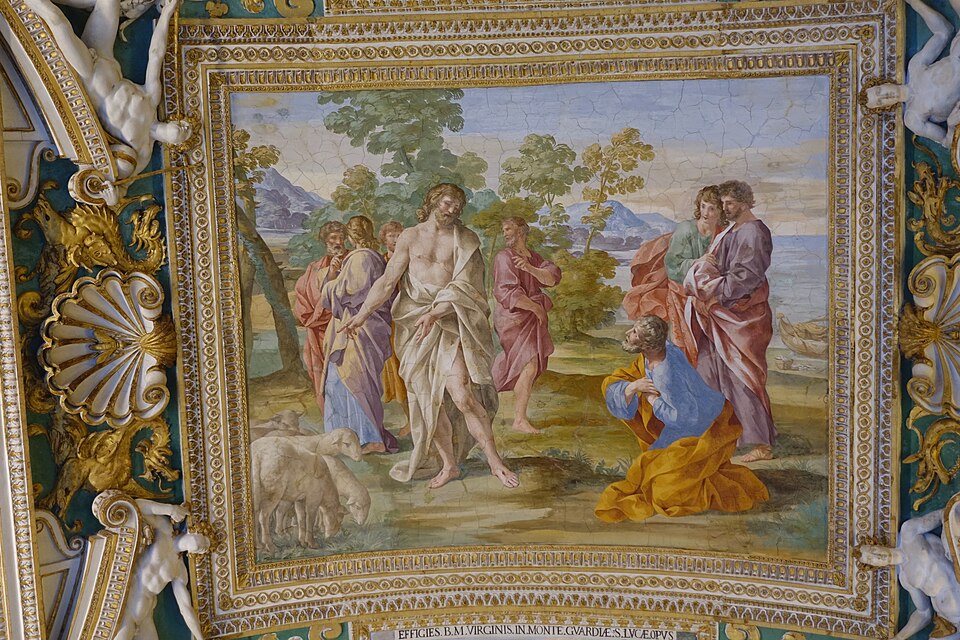
The Gallery of Maps, one of the most striking corridors in the museums, is not a modern addition: its 40 painted panels were completed between 1580 and 1583 by the friar and cartographer Ignazio Danti, commissioned by Pope Gregory XIII to depict every region of Italy in large-scale topographical detail, complete with scenes of famous battles fought on that ground. At 120 metres long, the gallery's gilded, stucco-decorated ceiling is as elaborate as the maps beneath it.
Just as celebrated, though easy to walk past too quickly, are the Raphael Rooms — the private apartments of Julius II, which the pope had a 25-year-old Raphael repaint rather than use rooms already frescoed by other artists nearby. The Stanza della Segnatura contains Raphael's School of Athens, a gathering of ancient philosophers each modelled, in part, on Raphael's contemporaries — Plato is widely thought to bear Leonardo da Vinci's features, and the brooding figure of Heraclitus in the foreground is believed to be a tribute to Michelangelo, who was frescoing the Sistine ceiling next door at the very same time.
Good to know
Pre-booking a timed entry online is essential — walk-up queues routinely stretch for hours, especially in the middle of the day. The first entry slot of the morning or one of the last slots in the afternoon are the best times to see the Sistine Chapel with any breathing room, since large tour groups tend to cluster around midday. The same dress code as St Peter's Basilica applies throughout the museums: shoulders and knees covered.
Some guided tours offer a genuinely useful shortcut: a special passage, via Bernini's Scala Regia, leads directly from the Sistine Chapel into St Peter's Basilica, letting visitors skip the separate security queue at the basilica's main entrance. It's normally only accessible as part of an organized tour rather than to independent ticket holders, so check when booking if this connection matters to you.