
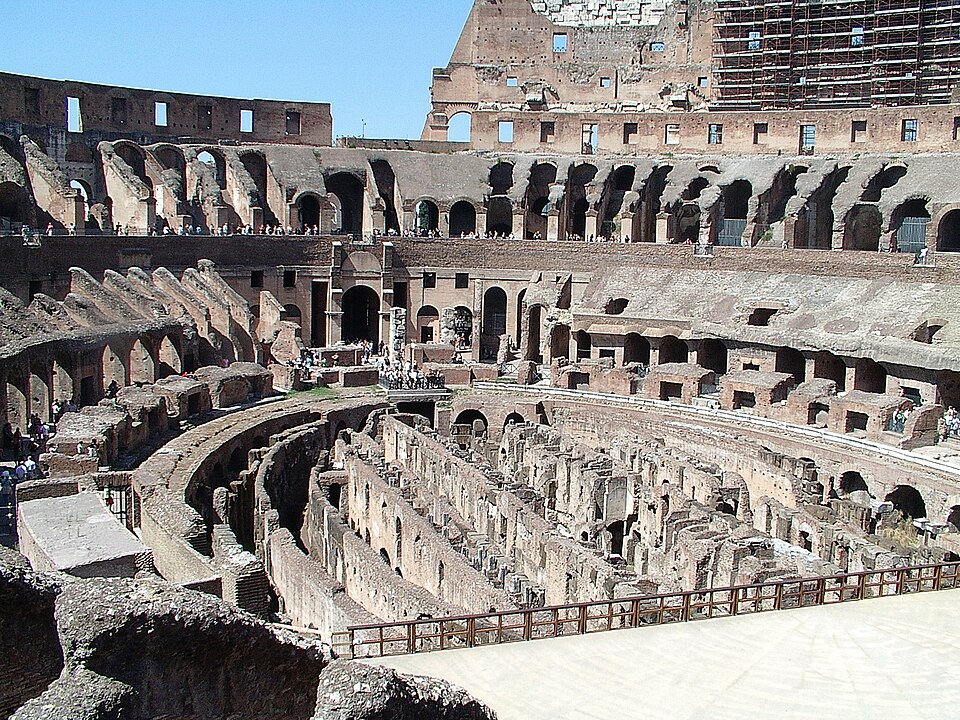
Colosseum
- historic
- Price: €16 - €22
- Opening hours: 08:30 - 19:00
History
Emperor Vespasian commissioned the amphitheatre around 72 AD, funding construction partly with the spoils of the Jewish War, on marshy ground where Nero had once kept an artificial lake within the grounds of his private Domus Aurea — a deliberate gesture of returning land the despised emperor had claimed for himself back to the Roman people. Vespasian didn't live to see it finished; his son Titus dedicated the building in 80 AD with games that ran for 100 days, during which, according to the historian Cassius Dio, thousands of animals were killed in hunts staged in the arena.
The structure survived largely intact for over a millennium, until a powerful earthquake struck central Italy in 1349 and brought down roughly two-thirds of the outer ring — the collapsed section had always stood on the softer, less stable ground toward the south. What the earthquake didn't finish, Renaissance and Baroque Rome did: popes granted licenses to quarry its travertine and marble, and stone stripped from the Colosseum went into St Peter's Basilica and several other landmark buildings, while the iron clamps holding its blocks together were pried out and melted down. The plunder only stopped in the 18th century, when Pope Benedict XIV consecrated the site in memory of the Christian martyrs believed to have died there.
The arena and its machinery
What visitors see today as an open floor was originally covered by a wooden stage, and beneath it ran the hypogeum, a two-level warren of tunnels and chambers added by Emperor Domitian about a decade after the amphitheatre opened. Slaves and animal handlers worked at least 32 capstan-operated lifts down there, hauling caged animals and stage scenery — and occasionally full-grown elephants — straight up through trapdoors in the floor, so a leopard or a lion could seem to simply appear in the middle of the arena with no warning.
Before that underground system existed, the low-lying arena could still be flooded for mock naval battles, staged at least once during the inaugural games of 80 AD; once Domitian's tunnels went in, the floor could never be flooded again. Overhead, a different kind of engineering shaded the crowd: the velarium, a canvas awning rigged from masts around the building's upper rim and worked by a team of imperial sailors experienced with ship's rigging, covered roughly a third of the seating, and the whole building held somewhere between 50,000 and 80,000 spectators, seated according to their rank in society.
Did you know?
For most of antiquity, Romans knew the building simply as the Amphitheatrum Flavium, after the Flavian dynasty that built it. The name "Colosseum" only caught on around the year 1000, borrowed from the Colossus of Nero, a giant bronze statue that once stood beside it — originally a portrait of Nero himself, later reworked into a likeness of the sun god so it could keep standing after his memory was officially disgraced.
Its bloody history has been turned into an unlikely modern symbol: since 1999, the Colosseum's night lighting switches from white to gold for 48 hours whenever a death sentence anywhere in the world is commuted, overturned, or a jurisdiction abolishes capital punishment altogether — a quiet reversal for a building once built for public executions and gladiatorial combat.
Good to know
A standard Colosseum ticket also covers the Roman Forum and Palatine Hill, valid for 24 hours from your entry slot, so it's worth spreading the three sites across a single flexible window rather than rushing them back to back. Walking the arena floor or descending into the hypogeum both require a separate, more expensive ticket that includes a mandatory guided visit, and slots for these sell out weeks in advance in high season — book as early as you can if you want to see the underground.
The Colosseum is one of the most visited monuments on earth, and midday queues can be long even with a timed ticket; the first entry slot of the morning or one of the last of the day are consistently the calmest times to visit. Security screening resembles an airport checkpoint, so arrive a few minutes early, and bring photo ID, since it's often checked against the name on the ticket.