
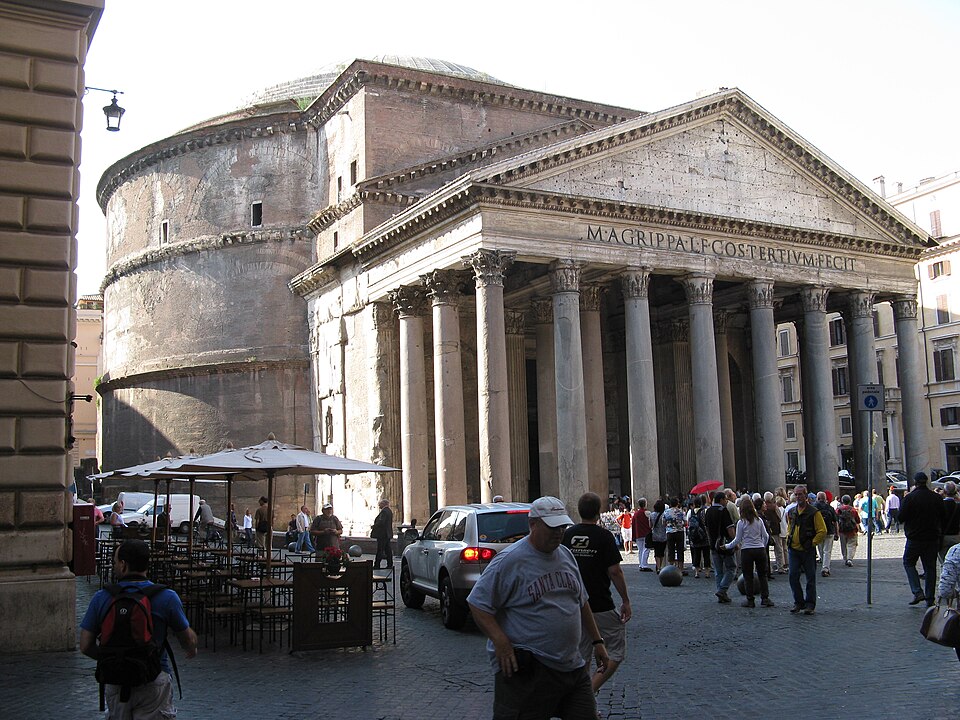
Pantheon
- historic
- sacred
- Price: Free
- Opening hours: 09:00 - 19:00
History
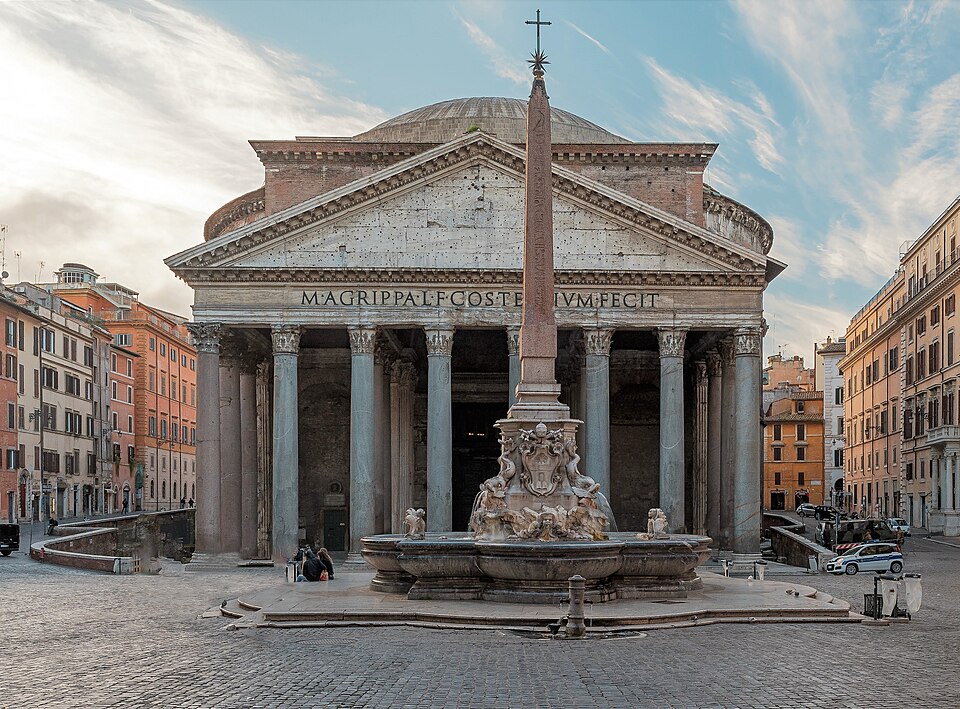
The Pantheon standing today isn't the original. Marcus Agrippa, right-hand man and son-in-law of the emperor Augustus, built the first Pantheon around 27 BC as a temple to "all the gods" (pan + theon in Greek). That building burned down, was rebuilt, and burned again, until the emperor Hadrian had it completely reconstructed from the ground up around 113-125 AD. Remarkably, Hadrian chose not to put his own name on the new building — he had Agrippa's original dedicatory inscription recreated across the facade, crediting a builder who had been dead for over a century, a gesture of modesty that also quietly linked Hadrian to the golden age of Augustus.
That's why the inscription across the portico still reads M AGRIPPA L F COS TERTIVM FECIT — "Marcus Agrippa, son of Lucius, three times consul, built this" — even though brick-stamp evidence confirms the structure behind it is entirely Hadrianic. For centuries, that inscription genuinely fooled scholars into dating the building to Agrippa's era; it wasn't definitively corrected until 18th and 19th century archaeologists began reading the bricks themselves.
An engineering marvel
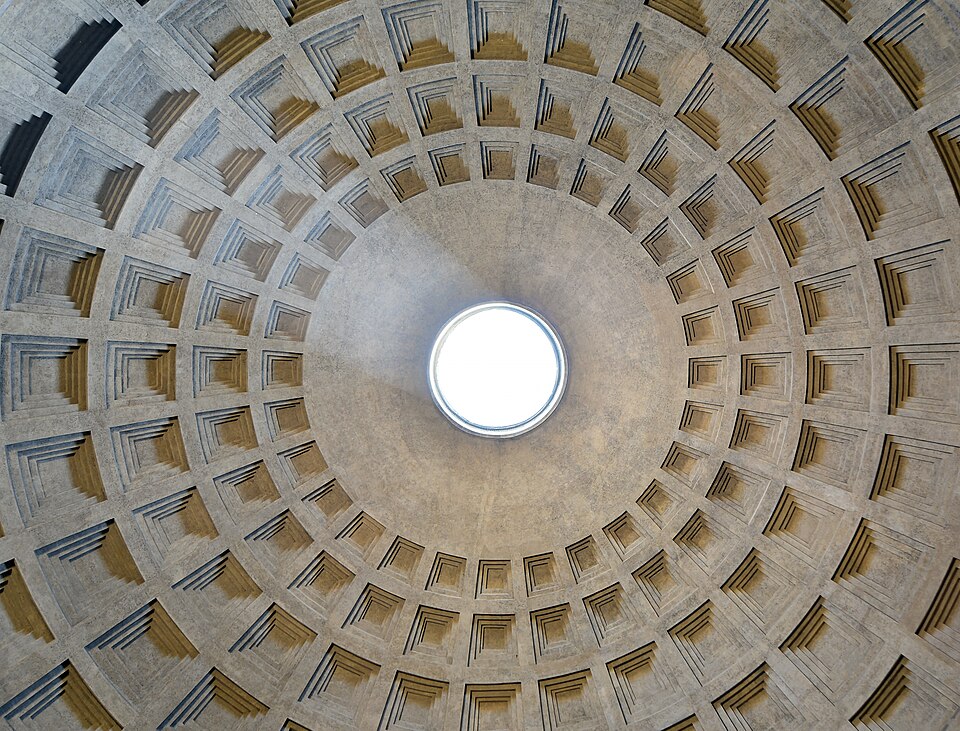
Nearly nineteen centuries after it was built, the Pantheon's dome is still the largest unreinforced concrete dome in the world, at 43.3 metres in diameter — and, unlike a modern dome, it has no steel reinforcement holding it up at all. Roman engineers pulled this off by varying the concrete itself: heavy travertine and brick at the base, progressively lighter volcanic stone and pumice as the dome rises, shedding weight exactly where the structure needed it least. The sunken square coffers ringing the inside of the dome do the same job decoratively, hollowing out material without weakening the shell.
At the very top, all of this converges on the oculus, a nine-metre opening that is the building's only source of light — and it is genuinely open to the sky, with no glass or covering of any kind. That means it rains inside the Pantheon; a subtly sloped marble floor with small drainage holes, largely still working after two thousand years, quietly carries the water away. On a clear day the oculus instead casts a slow-moving disc of sunlight across the coffered ceiling and walls, tracking the hours like the largest sundial in Rome.
Did you know?
In 609 AD, Pope Boniface IV received permission from the Byzantine emperor to consecrate the Pantheon as a Christian church, Santa Maria ad Martyres. That single act is very likely why the building survives so completely today: while most of pagan Rome's temples were stripped for stone and metal or left to collapse across the medieval centuries, the Pantheon was now a working church under papal protection, and so it kept its original bronze doors, its columns, and its dome intact.
The Renaissance painter Raphael asked to be buried here, and his tomb — a niche below a Madonna sculpted by Lorenzetto — has drawn visitors ever since his death in 1520. Three centuries later, in 1833, doubts about the tomb's exact location led to an excavation beneath the altar, which confirmed an intact skeleton exactly where tradition said it would be.
Good to know
The Pantheon is no longer free to enter: Italy introduced a paid-entry policy in 2023, and as of mid-2026 the standard ticket costs €7 (with reduced and free-entry categories for under-18s, Rome residents, and a few other groups). It's a working church as well as a monument, and Mass is still held on Sundays, so visiting hours can shift around services — booking a timed slot online ahead of your visit is worth doing in high season, when queues at the door can get long.
Because the oculus is permanently open to the elements, what you experience inside depends entirely on the weather: expect a sunbeam sweeping across the coffered dome on a clear day, and genuine rainfall on the floor during a storm — both are normal, not something to avoid. The Pantheon sits in the heart of the historic centre, an easy five-minute walk from Piazza Navona, so the two pair naturally into a single stroll.