
Piazza Navona
- piazza
- Price: Free
- Opening hours: Always open
Book a guided tour of Roma
Skip the line and see Roma with a local guide.
History
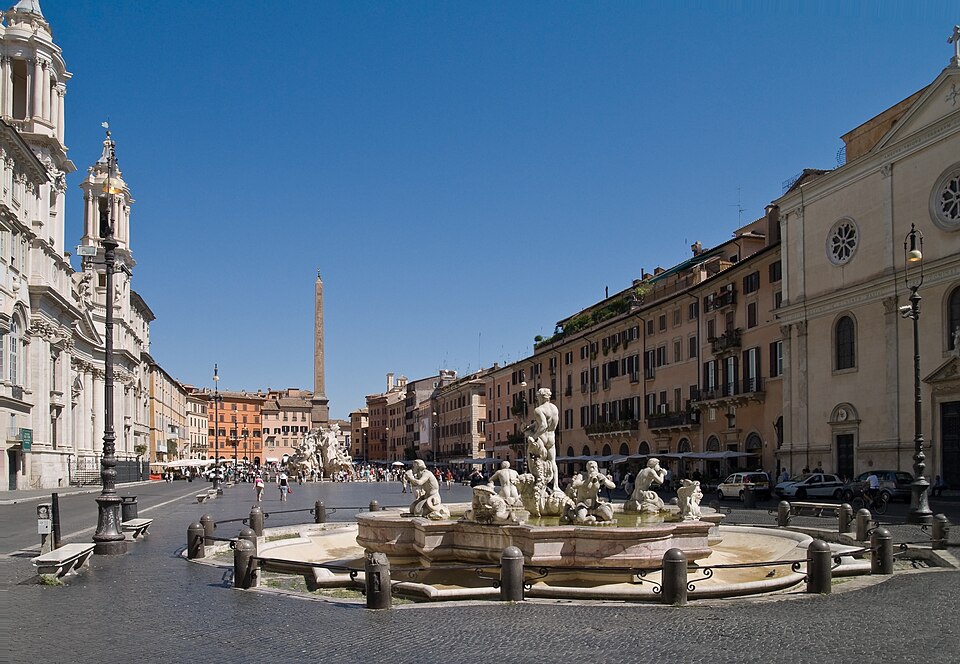
Piazza Navona sits directly on top of the Stadium of Domitian, an arena the emperor dedicated around 86 AD as Rome's first permanent venue for Greek-style athletic contests, or agones — a name that, filtered through centuries of dialect, is thought to have eventually softened into "Navona." Roughly 30,000 spectators could once watch footraces here, and the stadium's elongated oval is still exactly the shape of the piazza today; walk the perimeter and you're tracing the line of the ancient seating banks, with fragments of the original travertine structure still visible underground beneath the surrounding buildings.
After the stadium fell out of use, the site was gradually built over and by the Middle Ages had become one of Rome's main marketplaces, a role it kept for centuries. Its transformation into the grand Baroque space seen today came under Pope Innocent X Pamphilj in the mid-17th century, when his family palace and the church of Sant'Agnese in Agone rose along one side of the square and Bernini was commissioned to design its centerpiece fountain, cementing Piazza Navona's shift from ancient sports ground to one of the city's most theatrical public stages.
Did you know?
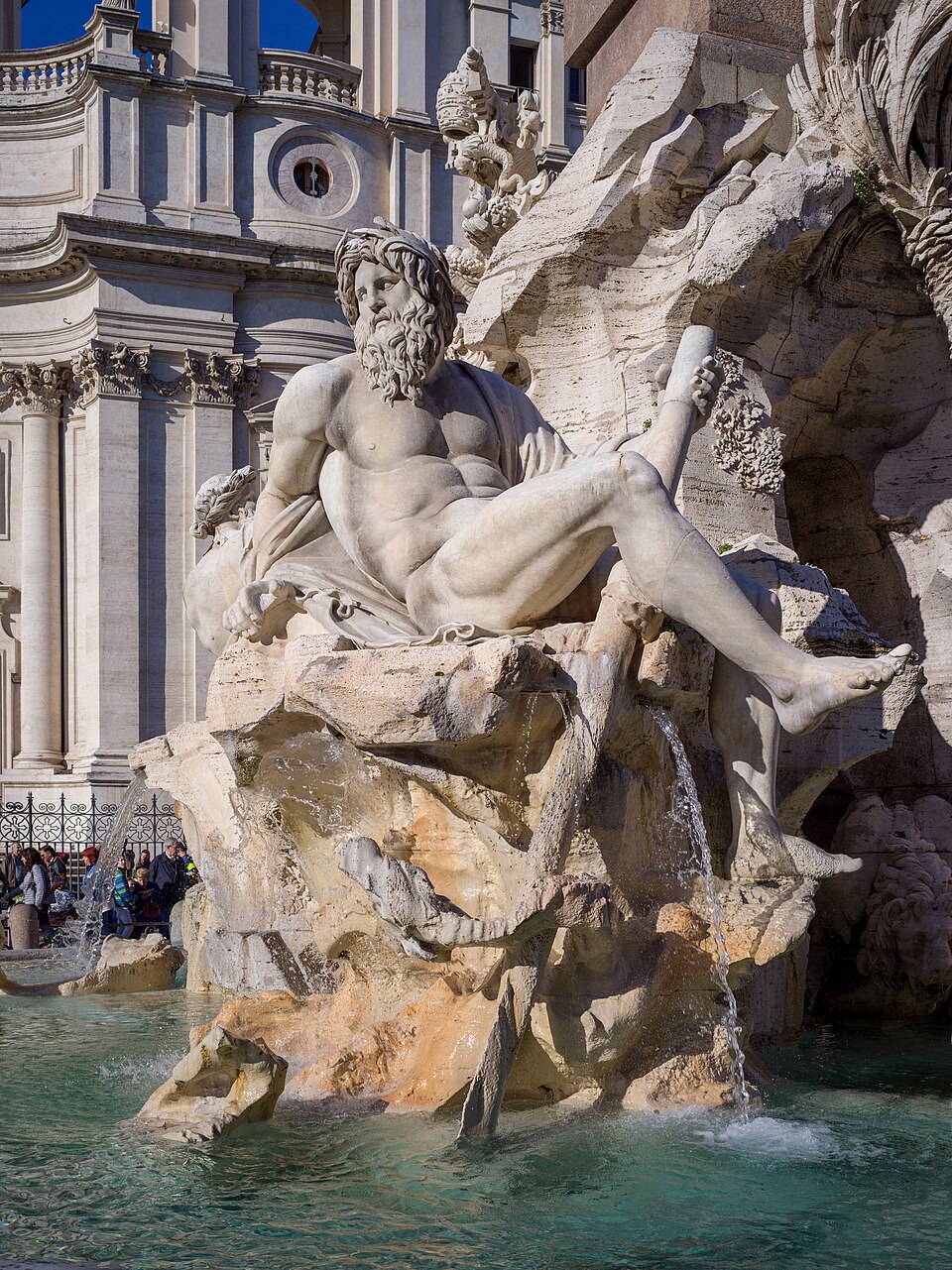
At the center of the square, Bernini's Fountain of the Four Rivers, unveiled in 1651, personifies the four great rivers of the continents known to 17th-century Europe: the Nile for Africa, the Ganges for Asia, the Danube for Europe, and the Río de la Plata for the Americas. Each river god is paired with plants and animals from its part of the world, all supporting an ancient Egyptian obelisk that Bernini had moved to the piazza from another site. Guides love to point out that the Nile's head is veiled and the Río de la Plata's arm is raised as if flinching, and tell visitors this was Bernini's sly dig at his rival Francesco Borromini, who designed the Sant'Agnese in Agone facade facing the fountain — as if the statues were shielding their eyes from, or bracing against the collapse of, Borromini's church. It's a wonderful story, but it doesn't quite hold up: the fountain was finished in 1651, while work on Borromini's facade didn't begin until the following year, so the figures can't have been sculpted with a building that didn't yet exist in mind. Historians read the gestures simply as compositional flourishes — the veiled head marking that the Nile's source was still unknown, the raised arm adding drama to the pose.
For roughly two centuries, from 1652 until the practice was banned in the mid-1800s on hygiene grounds, Romans flooded the square itself every summer. On summer weekends the fountains' drains were sealed and the piazza's floor, gently concave in a way it no longer is today, filled with water to create the so-called "Lago di Piazza Navona." Nobles rode through in carriages to cool off while ordinary Romans waded and splashed in the makeshift lake — a beloved, if now vanished, ritual of the Roman summer.
Good to know
Piazza Navona is free and open around the clock, so it rewards a visit at almost any hour — early morning for empty photos of the fountains, evening for the buzz of street artists, portraitists, and musicians who set up along its length. It's one of the most popular squares in Rome, which means it's often thick with tourists and tour groups by mid-morning through the afternoon; if you'd rather see it without the crowds, aim for early or late in the day.
The cafes and restaurants with tables right on the piazza charge a steep premium for the view, and the food rarely matches the price. Walk two or three minutes into the surrounding side streets and you'll find better, more honestly priced meals — save the square itself for a coffee, a gelato, or simply sitting on the steps to take in the scene.