
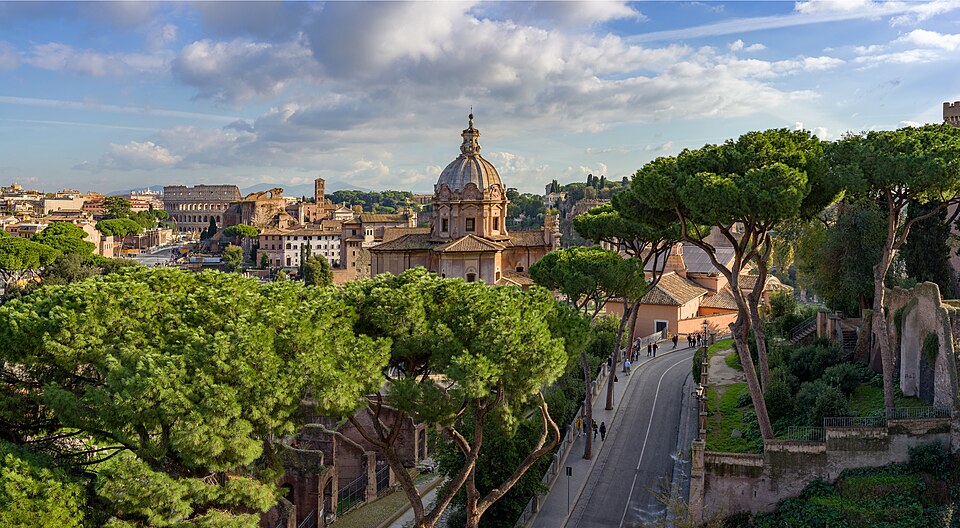
Roman Forum
- ruins
- Price: €16 - €22 (combined ticket with Colosseum and Palatine Hill)
- Opening hours: 08:30 - 19:00
History

Long before it became the ceremonial heart of Rome, the valley between the Palatine and Capitoline hills was a low, marshy stretch of ground, prone to flooding and used as a burial site by the small Iron Age settlements that would later merge into the city. Roman tradition credits the Etruscan kings of the 6th century BC with draining it by channelling the water into the Cloaca Maxima, a covered sewer whose route can still partly be traced today, turning the swamp into solid, buildable land. On that reclaimed ground grew the political, religious and commercial heart of the Roman world, anchored by buildings whose names still echo in modern languages: the Curia Julia, where the Senate met; the Rostra, the platform from which magistrates addressed the crowd; and the Temple of Saturn, which doubled for centuries as the state treasury.
For over a thousand years, emperor after emperor added arches, basilicas and temples to the Forum, layering monument on monument. After the fall of the Western Empire, the site slowly emptied out: stone and marble were carted off for other buildings, the nearby Tiber flooded it repeatedly, and centuries of silt and debris gradually buried everything but the tips of a few columns. By the Middle Ages it had become, quite literally, pastureland, known to Romans as Campo Vaccino, the "cow field," and it stayed that way until archaeologists began systematic excavations in the early 19th century. That work continued, controversially, in the 1930s under Mussolini, whose regime drove a new road, Via dei Fori Imperiali, straight through part of the adjoining Imperial Fora to link the Colosseum with Piazza Venezia.
Did you know?
The Rostra, the platform where Cicero and other famous orators once addressed the crowd, takes its name from the bronze ship's prows, rostra in Latin, that were mounted on its front after Rome's naval victory over Antium in 338 BC — captured trophies put on public display. The word is still with us today, surviving in "rostrum," the modern term for any speaker's platform.
For roughly three centuries — from sometime in the early Middle Ages until 19th-century archaeologists arrived with their shovels — one of the most important sites in the ancient world was, in practice, just a field. Local farmers grazed cattle over the buried ruins of the Senate House and the imperial temples, with barely a stone visible above the grass to hint at what lay beneath.
Good to know
Entry to the Roman Forum is included in the combined ticket with the Colosseum and Palatine Hill, valid for 24 hours across all three sites, so it's worth treating them as one long visit rather than three separate trips. Booking online in advance is strongly recommended, especially in high season, when lines at the ticket booths can take a long time.
The Forum is essentially an open-air archaeological site with very little shade, so bring water and sun protection, particularly in summer, and wear sturdy, flat shoes — the ancient paving is uneven and can be slippery. Set aside at least an hour and a half, ideally closer to two, to walk the site properly from the Arch of Titus toward the Capitoline Hill without rushing.