
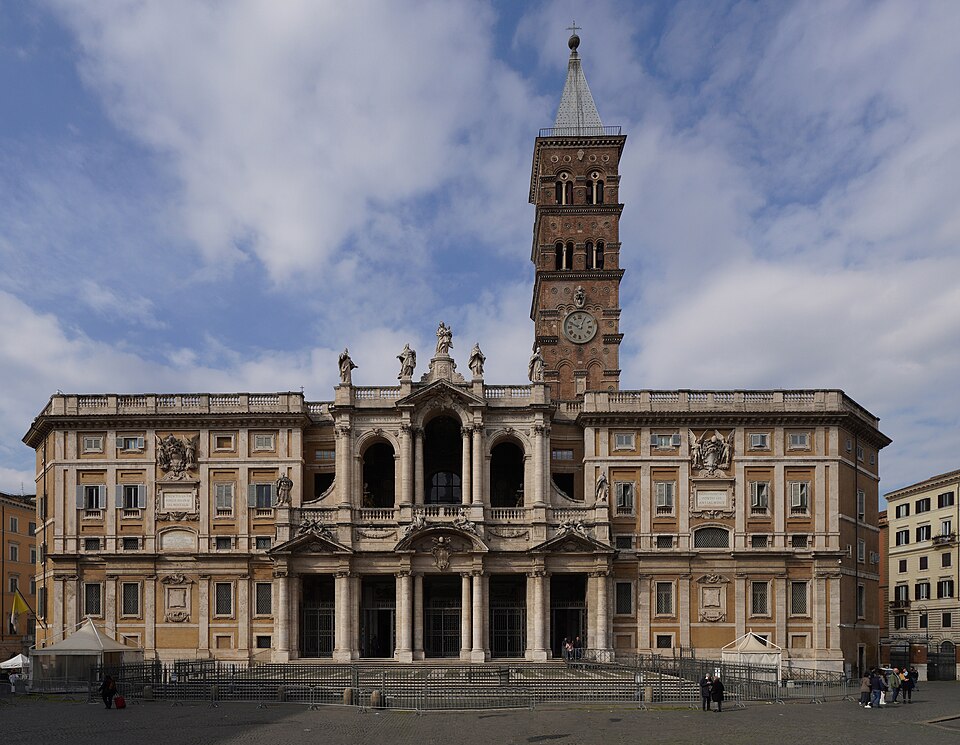
Basilica of Santa Maria Maggiore
- sacred
- Price: Free
- Opening hours: 07:00 - 18:45
History
According to a legend still told today, the basilica owes its existence to a summer snowfall. In the year 358, tradition holds, the Virgin Mary appeared on the same night in the dreams of a wealthy, childless Roman couple and of Pope Liberius, asking that a church be built for her wherever snow was found the next morning. On the fifth of August, snow was reportedly discovered blanketing the top of the Esquiline Hill in the middle of the Roman summer, and the pope is said to have traced the outline of the new church directly into it. It's almost certainly pious legend rather than history, but the story gave the basilica its older name, Our Lady of the Snows, and it's still remembered every year.
What can be dated with more confidence is that the basilica was built under Pope Sixtus III starting around 432, only a year after the Council of Ephesus formally declared Mary to be Theotokos, "Mother of God" — a title debated for generations beforehand. Sixtus's church, raised in direct celebration of that council's decision, is part of why Santa Maria Maggiore's mosaics rank among the oldest anywhere devoted to Mary. Today the basilica is one of Rome's four papal major basilicas, together with St Peter's, St John Lateran, and St Paul Outside the Walls — a status no other Marian church in the world shares.
Did you know?
The mosaics on the triumphal arch date to the 5th century, making them, alongside those in a handful of other Roman churches, some of the oldest surviving Christian mosaics anywhere in the world. Unlike many mosaics elsewhere in Rome that were reworked or replaced over the centuries, these have survived largely intact, offering a rare, direct window onto how the earliest generations of officially tolerated Christian art actually looked.
Look up in the nave and you'll see a coffered wooden ceiling glowing with gold — gilded, according to a long-standing tradition, with some of the very first gold that Christopher Columbus brought back from the Americas, given to the Spanish pope Alexander VI by Ferdinand and Isabella of Spain. Historians can't fully confirm the story, but it's repeated so consistently, by guidebooks and local guides alike, that it has become part of the basilica's own lore.
Good to know
Unlike St Peter's Basilica across town, Santa Maria Maggiore is free to enter and rarely sees the same crushing crowds, despite holding some of the oldest and most significant Christian art in Rome — which makes it a good stop precisely because you can take your time in front of the mosaics instead of being swept along by a tour group. For those who want more than the free nave visit, a separate guided tour climbs up to the panoramic terrace beside the dome, with rooftop views over the city, and is worth booking ahead.
If you happen to be in Rome on August 5th, time your visit for the basilica's yearly reenactment of the snow miracle, when white flower petals are released from the ceiling of the Pauline Chapel and drift down over the congregation — a small, genuinely charming piece of living tradition tied directly to the church's founding legend.