
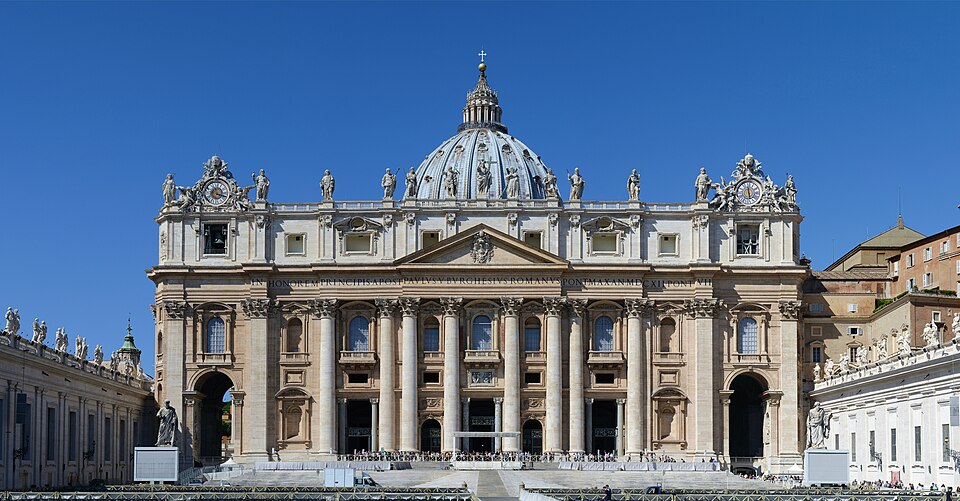
St. Peter's Basilica
- sacred
- Price: Free (dome access: €8-10)
- Opening hours: 07:00 - 19:00
History
Christian tradition holds that St Peter's Basilica stands over the burial place of the apostle Peter, martyred in Rome in the first century AD. In the twentieth century, archaeologists carrying out excavations beneath the high altar, commissioned by the Vatican itself, uncovered a Roman-era necropolis and, within it, a grave the Vatican identifies as consistent with that tradition. In 1968 Pope Paul VI announced that bone fragments recovered from the site had been "identified in a way that we can consider convincing" as Peter's remains — carefully worded, since no independent scientific proof of identity exists and some archaeologists still question the conclusion.
The building visitors see today is actually the second basilica on this site. Construction began in 1506 under Pope Julius II, replacing a fourth-century basilica built by the emperor Constantine that had stood for more than a thousand years. Donato Bramante drew up the first plan; after his death the project passed through several architects until Michelangelo took charge in 1547 and redesigned the dome that still crowns the building today. Carlo Maderno later extended the floor plan into a Latin cross and added the facade, while Gian Lorenzo Bernini contributed the sweeping colonnaded piazza and the bronze baldachin over the high altar. The basilica was finally consecrated in 1626, a full 120 years after the first stone was laid.
Michelangelo's Dome
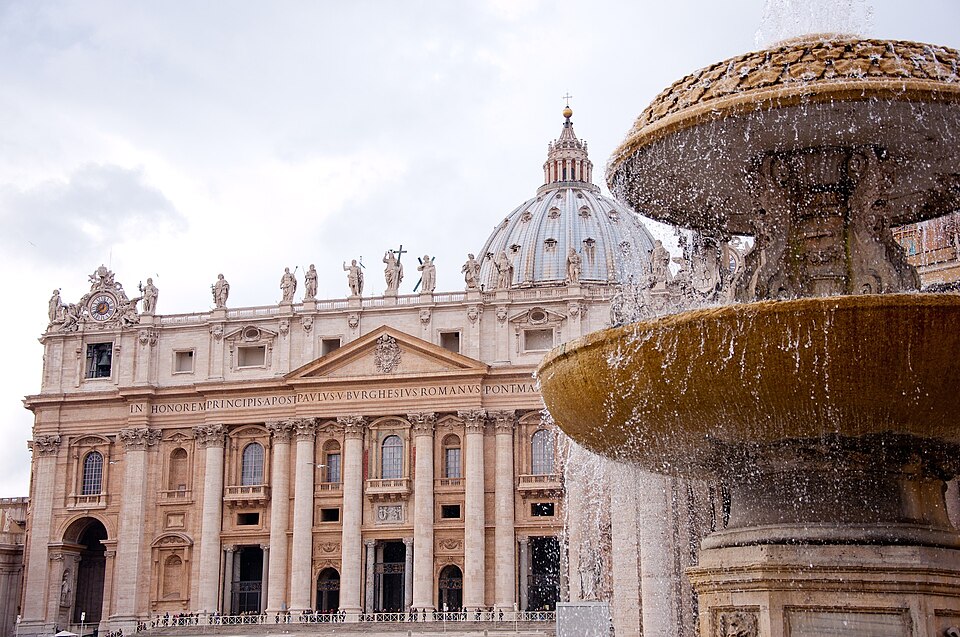
Michelangelo was already past seventy when he took over as chief architect in 1547, and he worked on the building, unpaid, for the rest of his life as an act of devotion. He lived to see only the drum of the dome finished; when he died in 1564, the cupola itself did not yet exist. Giacomo della Porta and Domenico Fontana completed it between 1588 and 1590 — a mere 22 months, using as many as 800 labourers — adjusting Michelangelo's design from a hemisphere to a slightly more pointed profile for greater structural stability.
At roughly 136 metres from the floor to the top of the cross, the dome remains, by long-standing convention, the tallest structure in Rome, and height limits in the historic centre keep it that way. St Peter's is also, by most measures, the largest church in Christendom: brass markers set into the nave floor mark the length of other great cathedrals around the world, and every one of them falls short of St Peter's own 218-metre length.
Did you know?
On 21 May 1972, a man named Laszlo Toth climbed over the barrier in front of Michelangelo's Pietà — the sculpture of the Virgin Mary cradling the body of Christ, completed when the artist was in his early twenties — and attacked it with a geologist's hammer, shouting that he was Jesus Christ. He struck the marble around fifteen times before horrified bystanders pulled him away, breaking off Mary's arm at the elbow and chipping her nose and an eyelid. Restoration took months, and the Pietà has stood behind protective glass ever since — the only sculpture in the basilica displayed this way.
Walking through the basilica's doors technically means leaving Italy: St Peter's sits inside Vatican City, an independent state of under half a square kilometre, and a line across St Peter's Square marks the border. Bernini designed his colonnade — four rows of columns, 284 in total — to feel like two arms reaching out from the church to embrace everyone arriving in the piazza, a metaphor he is said to have described in exactly those terms.
Good to know
Entry to the basilica is free, but expect airport-style security screening and, in peak season, queues stretching across the piazza; arriving early morning or in the last hour before closing usually means a shorter wait. A strict dress code applies to everyone without exception — shoulders and knees covered for both men and women — so save the shorts and sleeveless tops for later in the day.
Climbing the dome is a separate, ticketed experience: choose the full climb of 551 steps on foot, or a shorter route that takes an elevator partway before still finishing with around 320 steps on an increasingly narrow spiral staircase. Book online in advance to skip the on-site ticket line. Because the basilica lies inside Vatican City, quiet, respectful behaviour is expected throughout — photography without flash is generally permitted in the nave, but keep your voice down out of consideration for those praying.